
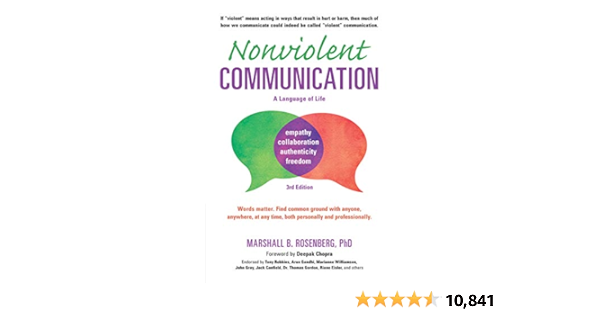
- core beliefs
- go with intrinsic motivation: give & receive out of compassion as the motivation, i.e. purely the desire to contribute to one’s wellbeing & enrich one’s life (self or other’s)
- getting people to agree/act out of fear/shame/duty/pressure diminishes good will in the long term
- language plays a crucial role
- life-alienating communication: e.g. moralistic judgments, comparison
- 4 step of NVC (non-violent communication)
- “I observed that __. I feel __ because I need __. Can you __?”
- 1 - observations
- not necessary to remain completely objective and avoid evaluation, just make sure to separate observations & evaluations
- 2 - feelings
- we often use the word “feel” followed by judgements rather than actual feelings
- develop vocabulary of feelings
- take responsibility of feelings
- what others say and do may be the stimulus, not the cause
- our needs + how we choose to receive what others say/do → feeling
- instead of (a) self-blame, (b) blame speaker → follow feeling by needs (”I feel __ because I need __”)
- 3 - needs
- we all have physical needs: air, water, food, rest
- we have psychological needs such as understanding, support, honesty, and meaning
- separate needs from strategies
- 4 - requests (not demands)
- use positive/actionable language (”do this”, instead of “don’t do that”)
- make requests concrete, be specific
- requests are received as coercion when others believe they will be judged/blamed/punished if they do not comply
- on listening
- other people might not communicate this way. Listen to what people are actually needing.
- empathetic listening: listen to another person with full presence, reflect back to them, allow them to fully express before turning to our requests
- when we sense ourselves being defensive: (1) stop/breathe, (2) scream nonviolently (express pain without blame), (3) take time out
- interrupting empathetically is better than pretending to listen. one can also openly express desire to be more connected
- on self-compassion
- if we find ourselves approaching self blame, stop and ask what are the underlying unmet needs, then follow with the self-forgiveness and attention of the part of self that chose to act this way, recognize that it was an attempt to serve life but just fell short of fulfilling some needs
- use “i choose to __ because I want __” instead of “i have to”
- on expressing anger
- separate the person from the responsibility for our anger
- 4 steps: (1) stop/breathe, (2) identify thoughts that makes us angry, (3) connect to the unmet needs, (4) express the feeling framed based on our unmet needs, without blame
- on conflict resolution
- focus on creating that quality of mutual concern and respect where each party thinks their own needs matter
- (1) express our own needs, (2) search for the real needs of the other person no matter how they are expressing, (3) verify that we accurately recognized their needs, (4) provide empathy to allow mutually hear each other’s needs, (5) propose strategies with positive action language
- use role play to speed up the conversation and avoid each party telling the same stories repeatedly
- on protective use of force
- focusing on the life or rights we want to protect, without passing judgment
- concern on spanking/punishing children: their fear of punishment might obscure their understanding of the compassion behind parents’ demands
- on counseling
- focus on connecting rather than diagnosing
- on appreciation
- judgements, both positive and negative, are life alienating
- NVC appreciation: sole intention is to celebrate the way our lives have been enriched by others, not to get something in return
 Made with Bullet